Fabrizio Collini
The Collini CaseFabrizio Collini is the Italian defendant at the center of the murder trial of Hans Meyer. His first response to the case is an unqualified admission, coupled with a refusal of legal help and an unwillingness to explain himself. That silence makes the trial’s later disclosures carry unusual weight: the reasons he gives for waiting to kill Meyer, and the small photograph he leaves behind, reveal a life that the courtroom’s legal procedure can expose only in fragments.
Identity and Introduction
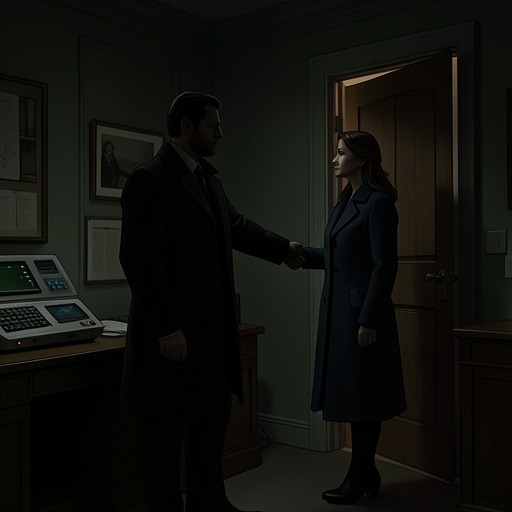
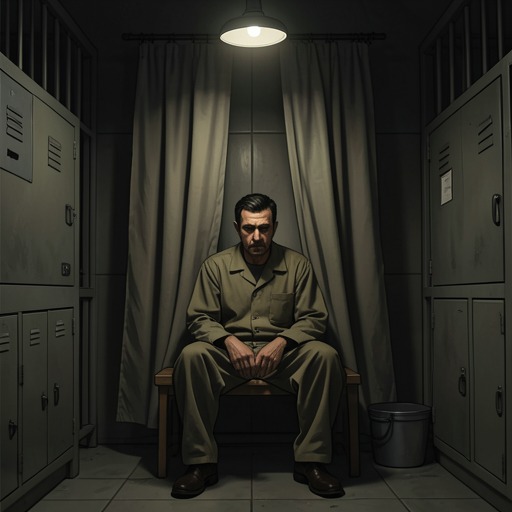
Collini gives his full name as Fabrizio Maria Collini and identifies himself as Italian, born on 26 March 1934 in Campomorone, near Genoa. At his first meeting with Caspar Leinen, he is in handcuffs on a narrow landing above the prison cells. The confined setting places lawyer and client together before Collini has agreed to any relationship between them; Leinen introduces himself, but Collini says he does not need a lawyer.
That refusal cannot settle the matter. Leinen explains that the law requires a defendant in a case like this to have a lawyer. Collini answers that he does not want to be defended, then states plainly that he killed the man. In this first encounter, he gives the essential fact of his responsibility while withholding every circumstance that might make it intelligible. His silence is not uncertainty about who committed the killing; it is a boundary around what he will say.
Childhood and the Past Reconstructed
The novel gives Collini’s childhood a precise date and a sharply particular setting. On 14 November 1943, he is nine years old and has just left confirmation class. He cycles seventeen kilometres from the schoolhouse back to his father’s farm, where he imagines changing out of his formal suit and meeting other children at the old mill. The account situates this ordinary journey amid Italy’s upheaval: the Allied landing in Sicily, Mussolini’s overthrow, the armistice, and the establishment of the Italian Social Republic under German protection form the political background to a child’s immediate concerns.
The details of that childhood are domestic and concrete. Collini regards himself as master of one cow, four pigs, eleven chickens, and two cats. He has a bicycle, field glasses, and a pocketknife with a stag-horn handle; he has also seen a crashed plane and two dead soldiers. His sister is six years older, and he admits that he usually could not stand her. These details do not by themselves explain the later murder, and the narrative does not present childhood as a simple key that unlocks it. Instead, the court’s reconstruction makes visible the distance between the silent adult defendant and the child whose life once included a farm, school, siblings, and plans for the afternoon.
That past reaches the courtroom through Leinen’s first plea. As he presents Collini’s childhood, the sentences become images for those listening; the account changes Leinen’s understanding of criminal proceedings, which he recognizes as concerning abused human beings as well as legal questions. The shift matters to Collini’s portrayal: his history is not offered as an excuse spoken by Collini himself, but comes into view through the work of his defense and the court’s hearing of it.
The Murder and Its Stated Motive
During the trial, Richard Mattinger asks why Collini waited so long before killing Hans Meyer. Leinen is about to say that his client will answer in writing, but Collini rises and asks to speak for himself. It is the first time the courtroom has heard his deep, soft voice. He tells Mattinger that his uncle died long ago and that his Aunt Giulia died on 1 May 2001. She had struggled with the thought of him going to Germany for work and, he says, would not have survived the thought of him in a German prison as well. He waited until she had died; only then did he kill Meyer.
This explanation establishes a specific reason for the delay without making Collini’s account broader than he makes it. The death of his aunt is the condition he names for acting, and his statement connects his life in Germany, the prospect of imprisonment there, and his family’s distress. He calls this the whole story, then sits down carefully and without noise. His intervention is brief, but it changes the trial: a defendant who had initially refused even to be defended has chosen, at a decisive moment, to answer the question addressed to him directly.
Silence, Judgment, and the Ending
After the expert evidence, the court adjourns. The courtroom empties slowly, and Collini remains silent beside Leinen for a long time. When he finally speaks, he says he is not good with words and does not think they have won. He recalls an Italian saying: the dead do not want revenge; only the living do. He adds that he spends his days in his cell thinking about it. The statement does not withdraw his account of the killing or resolve the trial’s moral and legal questions. Instead, it places the act beside a distinction between the dead and the living, while making clear that the question of revenge continues to occupy him in custody.
At the next session, Collini has not been brought to court. The presiding judge announces that he took his own life in his cell the previous night, with the forensic pathologist placing his death at 2:40. The court discontinues the trial, and the state is to bear the costs and necessary expenses. The legal proceeding ends not with a verdict on Collini, but with his absence and the formal closure of the case. His empty chair remains in the courtroom as the journalists hurry away and Leinen stays behind.
An envelope marked for defending counsel is then delivered to Leinen. Inside is a brittle, faded black-and-white photograph of a girl of about twelve in a pale blouse, looking into the camera. On its reverse, in Collini’s handwriting, he identifies her as his sister and apologizes for everything. The photograph returns the story to the sibling mentioned in the account of his childhood, but it does not explain what each part of that apology means. Its smallness and incompleteness are essential: Collini leaves Leinen neither a full confession nor a final argument, only an image and a few words. After a trial that had to assemble his past from evidence and testimony, this is his last, personal act of communication.